Vintage Jewelry Identification: A Visual Guide
Learn to identify vintage jewelry by era, style, and maker. A visual guide to hallmarks, design characteristics, and the details that signal value.
You can identify most vintage jewelry by three things: the era it reflects, the hardware and construction techniques used, and the hallmark stamped on the metal. Together these pin down age, quality, and often the maker—usually without any specialist tools. Here's how to read each one.
How do I date jewelry by its era?
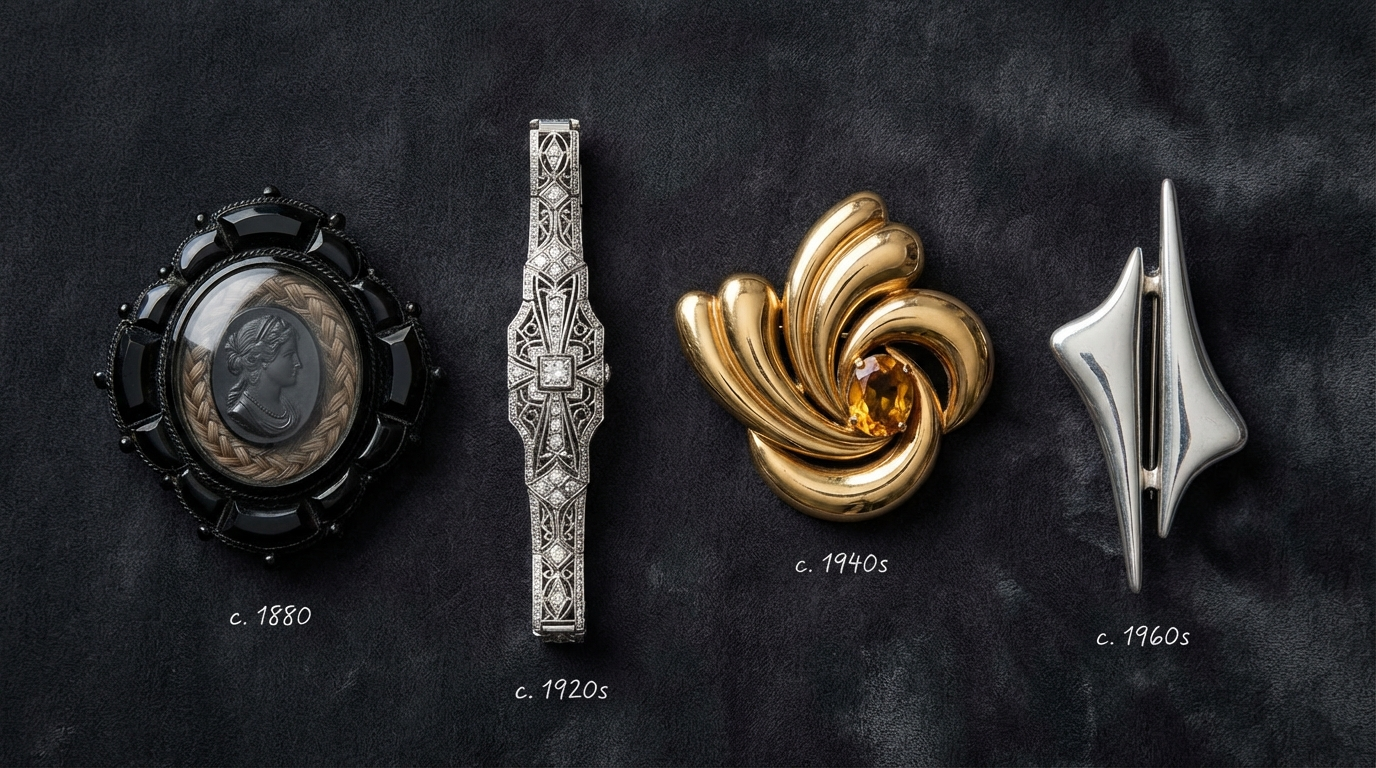
Victorian (1837-1901)
Design hallmarks: Romantic motifs—hearts, flowers, bows, snakes (symbolizing eternal love). Mourning jewelry featuring black materials. Intricate, often asymmetrical designs.
Materials: Yellow gold dominant. Jet, coral, seed pearls common. Paste (early glass gemstones) in less expensive pieces.
Construction: C-clasps and tube hinges on brooches. Trombone clasps on early pieces. No safety mechanisms.
Look for: Hand-engraving, unusual colored stones, memorial or sentimental inscriptions.
Art Nouveau (1890-1910)
Design hallmarks: Flowing, organic lines. Nature motifs—flowers, insects, flowing female figures. Whiplash curves.
Materials: Less focus on precious stones, more on design. Enamel work common. Plique-à-jour (backless enamel) in fine pieces.
Construction: Often complex, sculptural forms. Hard to mass-produce, so quality tends to be higher.
Look for: Signatures (these pieces often signed). Enamel in good condition. Dramatic, swooping lines.
Edwardian (1901-1915)
Design hallmarks: Delicate, lacy, feminine. Garlands, ribbons, bows. White-on-white color palette.
Materials: Platinum dominant in fine jewelry. Diamonds and pearls. Filigree work.
Construction: Extremely delicate settings. Milgrain edges (tiny beaded borders). Safety clasps appear.
Look for: The platinum-and-diamond combination. Extraordinary delicacy. Milgrain edges.
Art Deco (1920-1935)
Design hallmarks: Geometric patterns—squares, triangles, chevrons. Bold color contrasts. Symmetrical designs.
Materials: Platinum, white gold, contrasting colored stones. Onyx, coral, jade, lapis lazuli with diamonds.
Construction: Precision-cut stones. Channel and pave settings. Clean lines.
Look for: Strong geometric shapes. Color contrast. Symmetry.
Retro (1935-1950)
Design hallmarks: Big, bold, three-dimensional. Hollywood glamour. Bows, flowers, but stylized and oversized.
Materials: Rose and yellow gold return (platinum restricted during WWII). Large semi-precious stones—amethyst, aquamarine, citrine.
Construction: Often hollow to save metal. Mechanical parts (moving elements, hidden watches).
Look for: Scale—these pieces are substantial. The characteristic rose gold color. Industrial-era boldness.
Mid-Century Modern (1950-1970)
Design hallmarks: Abstract forms, modernist aesthetics. Scandinavian influence—clean, organic shapes. Space-age themes in 1960s.
Materials: Gold, silver, enamel. Unusual materials embraced—wood, enamel, abstract-cut stones.
Construction: Often artist-made or designer pieces. Studio jewelry movement begins.
Look for: Designer signatures (this era highly collectible). Unusual abstract forms. Artist-made quality.
How do I read jewelry hallmarks?
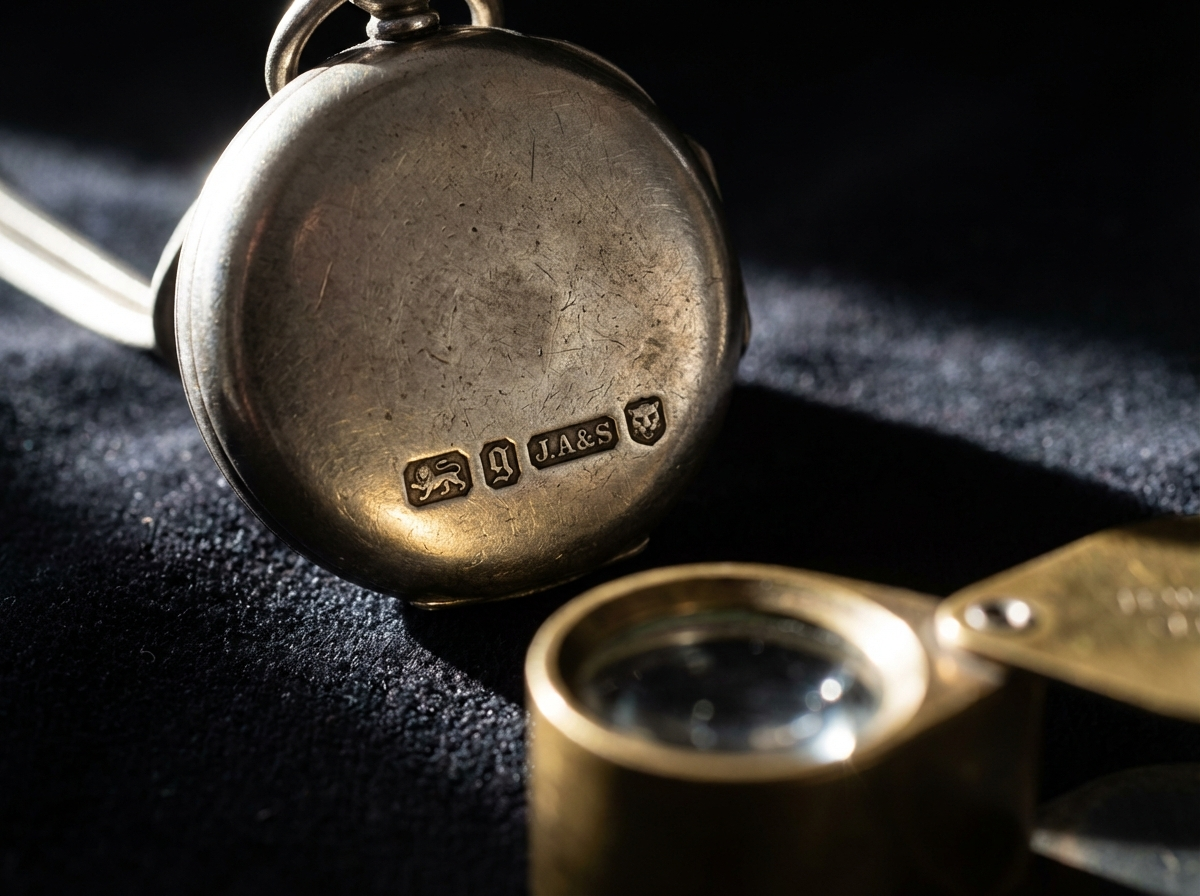
Hallmarks tell you what metal you have and often where and when it was made. Reference libraries like the Antique Jewelry University catalog thousands of these marks by country and era.
Gold Marks
Purity marks:
- 750 or 18K = 75% gold
- 585 or 14K = 58.5% gold
- 375 or 9K = 37.5% gold
- GP, GF, RGP = gold plated, gold filled, rolled gold plate (not solid)
Country of origin: British hallmarks include date letters and assay office marks. French hallmarks use eagle or owl symbols. Italian pieces often marked with star and number.
Silver Marks
Purity marks:
- 925 or Sterling = 92.5% silver
- 800 = European silver standard
- EPNS = electroplated nickel silver (not solid)
British silver hallmarks include lion passant (sterling standard), date letter, maker's mark, and assay office.
Platinum Marks
Purity marks:
- PLAT, PT, or 950 = platinum
- IRID PLAT = iridium platinum alloy
Platinum became common in jewelry around 1900. Its presence usually indicates quality.
How can I tell if costume jewelry is vintage?
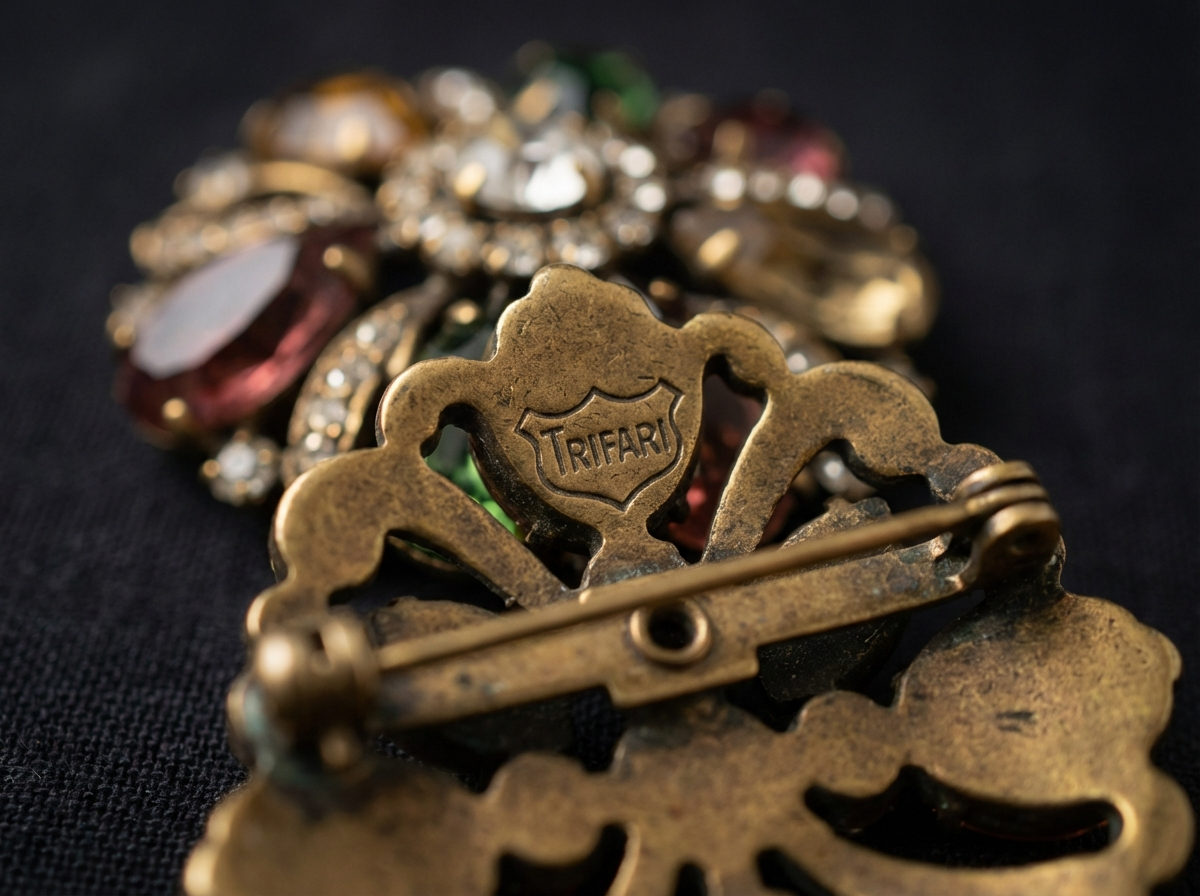
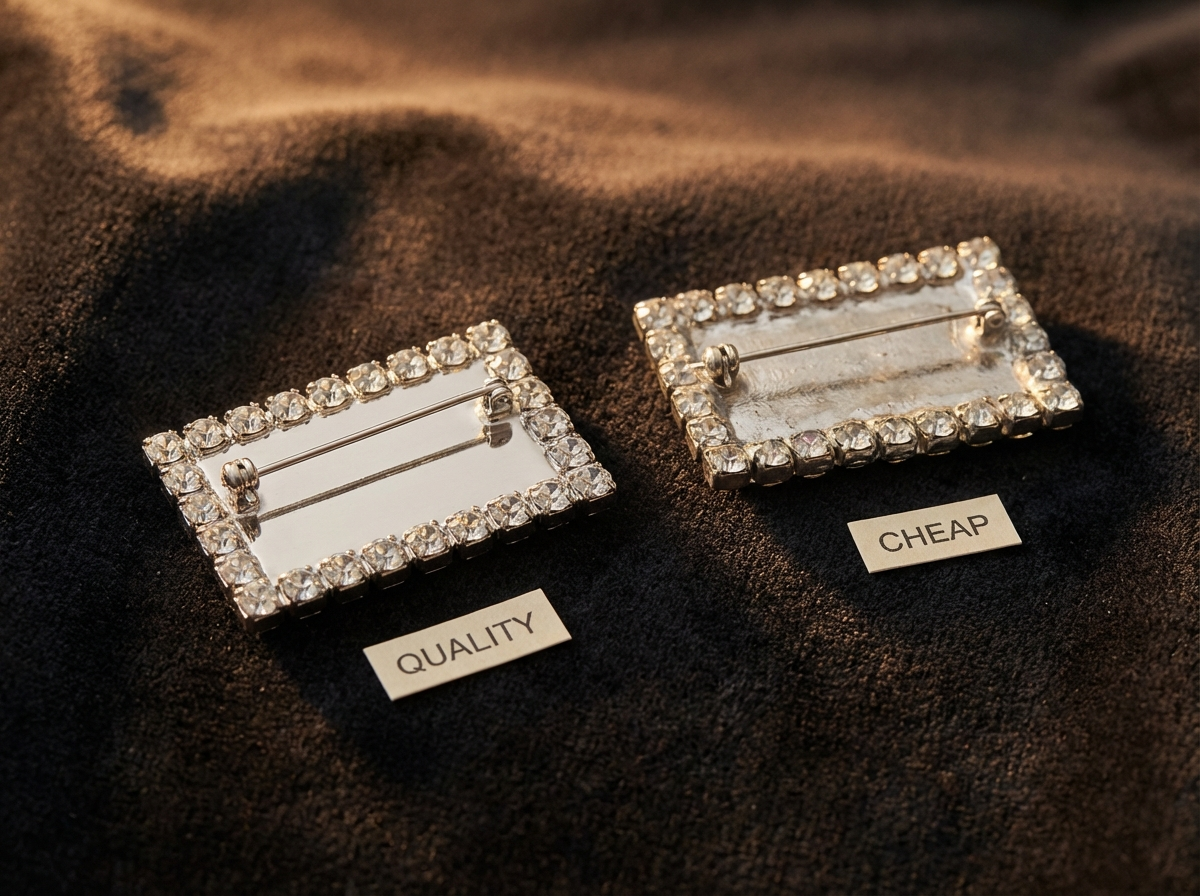
Costume jewelry—made from non-precious materials—can be valuable when it's from the right makers and eras. Price guides like Kovels track what signed pieces from these makers actually bring at sale.
Valuable Costume Makers to Know
High-end (often $100-$500+):
- Miriam Haskell (unsigned until 1950s)
- Eisenberg (especially "Eisenberg Original")
- Trifari (especially Crown Trifari, Jelly Bellies)
- Coro and Corocraft (Duettes especially collectible)
- Hattie Carnegie
- Schiaparelli (signed pieces rare and valuable)
Mid-tier collectible:
- Weiss
- Lisner
- Sarah Coventry
- Monet
- Napier
Signs of Quality Costume Jewelry
Weight: Better pieces have heft. Thin, light pieces suggest cheaper manufacture.
Setting: Prong-set stones rather than glued. Smooth, finished backs rather than rough.
Stones: Quality rhinestones with good foil backing. Austrian crystal especially desirable.
Closures: Working, well-made clasps. Original closures intact.
Red Flags for Fakes and Reproductions
- Modern safety pins where vintage clasps should be
- "Vintage-style" marketed pieces (modern reproductions)
- Inconsistent aging (tarnish only in some places)
- Glued stones coming loose
- Obviously modern materials (certain plastics)
What tools help identify vintage jewelry?
When visual identification isn't enough, technology helps:
Loupe or magnifier: Essential for reading small hallmarks and assessing stone settings.
Magnet: Real gold and silver aren't magnetic. (Some clasps and findings may be, but the body shouldn't.)
Acid test kits: For serious verification of metal content. Requires sacrificing a small scraping. For gemstones, the Gemological Institute of America is the reference standard for grading and identification.
Appraisal apps: Quick identification from photos can identify maker and era, pulling from databases of vintage jewelry images and auction records.
The Bottom Line
Vintage jewelry rewards attention. The details—hallmarks, construction, design elements—tell a story if you know how to read them.
Start with era (the overall style). Check for marks (the specific provenance). Assess quality (construction details). And when you find something promising, research the specific maker.
The piece that looks like "old costume jewelry" might be signed Eisenberg. The plain gold ring might be Georgian. The only way to know is to look closely.