Is Your Old Cast Iron Skillet Worth Money?
Most old cast iron skillets sell for $25–$75, but a Griswold #8 brings $285 and rare pieces reach $10,000. Here's how to read the marks on the bottom.
Most old cast iron skillets are worth $25–$75, but pans from Griswold, Wagner, and a handful of other foundries sell for $150–$400 in everyday sizes and thousands in rare ones. A Griswold large block logo #8 sold on eBay for $285, a pre-Griswold "ERIE" #8 brought $395, and an ERIE Spider skillet set the record at $10,000 at auction in 2024. What separates the $40 pan from the $400 one is the foundry, the logo style, and the size number, all cast into the bottom. Here's how to read them.
How much is old cast iron actually worth?
Most old cast iron is worth $25–$75. Unmarked pans, 1960s and later Wagner and Lodge, and anything with a pebbly cooking surface fall here. A pre-1970 Lodge "three-notch" skillet, the kind with three notches in the heat ring, sells for about $75, which is still more than a new Lodge costs at retail.
The middle tier lives at $150–$500. Everyday sizes from Griswold and Wagner's collectible eras land here: a Wagner Ware Sidney -O- #8 at $185, a Griswold large block logo #8 at $285, an ERIE #8 at $395. The top tier starts around $1,000 and climbs fast for unusual sizes, early logos, and specialty pieces. At the November 2025 collector auction in Montgomery, Indiana, a Griswold large block logo #13 skillet hammered at $3,200, a slant-logo #13 at $2,400, and a Griswold two-loaf bread pan at $11,250.
Prices have climbed steadily. Common Griswold #8s sold for $20–$25 each around 2012. The same pans bring ten times that now.
Which cast iron pans are worth real money?
The $2,000+ tier: rare sizes, early logos, and oddities
Griswold #13 and #20 skillets. Griswold made very few of its largest skillets. A large block logo #13 hammered at $3,200 and a #20 hotel skillet at $1,400 in November 2025; eBay sales of #14s have reached $3,249.
ERIE Spider skillet (1890s). A three-legged skillet with a spider cast into the bottom, made in Erie, Pennsylvania before the Griswold name appeared on cookware. One sold for $10,000 in August 2024, and a pitted example still brought $4,000 in February 2025.
Tiny and toy sizes. A Griswold slant-logo "ERIE" #1 skillet sold for $9,750, and a #0 toy waffle iron for $2,700. Collectors want the extremes.
Specialty pieces. Bread pans, gem pans, waffle irons, and kettle stands from the collectible foundries regularly bring $1,000–$5,000. A Sidney Hollow Ware kettle stand sold for $4,700.
The $150–$1,000 tier: everyday Griswold, Wagner, and Wapak
Griswold slant logo (1906–1929) and large block logo (1920–1940). The two most-collected marks. Everyday sizes (#5 through #10) sell for $150–$400, with the slant "ERIE" and "Griswold's Erie" variants higher. A slant-logo #2 with heat ring hammered at $1,550.
Wagner Ware Sidney -O- (1920s–1950s). Wagner's best pans, marked with the stylized "Sidney -O-" on the bottom. A #8 sells for about $185; larger sizes and pie-logo pieces climb to $1,000.
Wapak Indian Head. Wapak Hollow Ware of Ohio cast a Native American head medallion into some pans. A #12 sold for $1,050 and a #4 for $625.
Favorite Piqua Ware, Sidney Hollow Ware, and Victor. Smaller foundries with loyal collectors. A Favorite "Smiley" #7 that sold for $10 in 2012 now lists for $50–$125.
The $40–$150 tier: small block Griswold, Wagner, and early Lodge
Griswold small block logo pans (1939–1957), plain Wagner Ware, Birmingham Stove & Range "Red Mountain" pans from the 1930s–40s, and Lodge three-notch skillets. Solid, cookable, and worth more than a new pan, but common enough that prices stay reasonable.
Under $40: what most kitchens actually have
Unmarked 1960s–1990s skillets, post-1973 Griswold made under Textron ownership, modern Lodge with a pebbled surface, and anything cracked, warped, or burned. Great pans. Not collectibles.
How do you identify a valuable cast iron pan?
The logo dates the pan
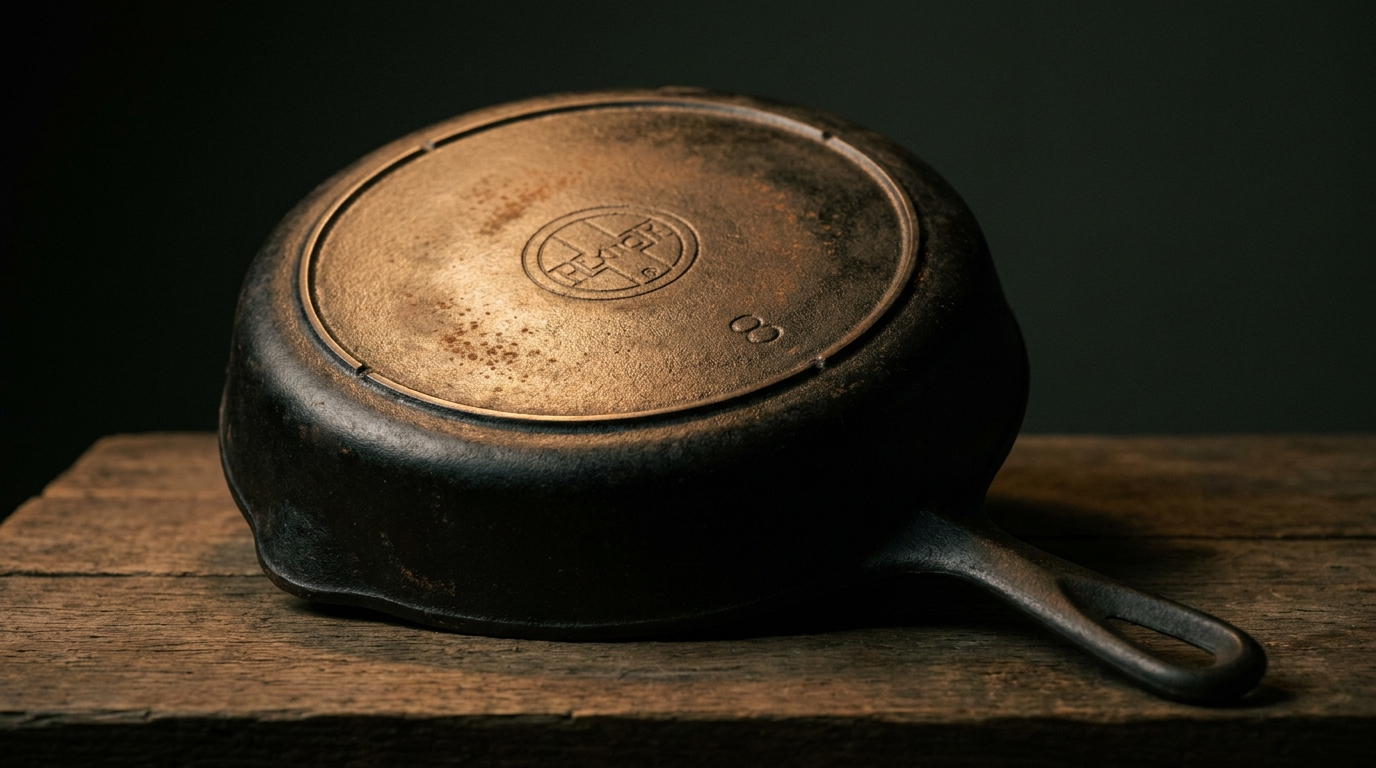
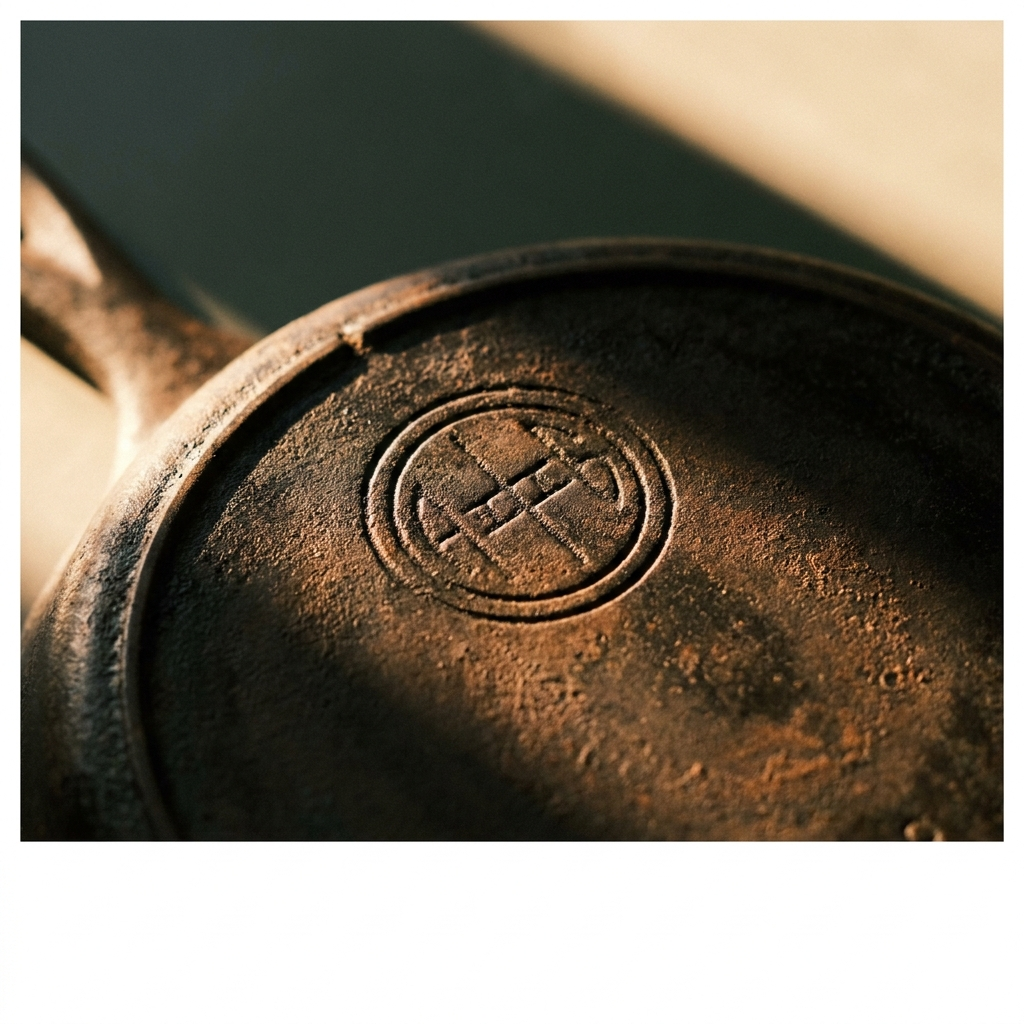
Turn it over. Griswold changed its trademark every couple of decades, and the Cast Iron Collector's reference maps each one: the "ERIE" diamond from 1884 to 1909, the slant-lettered "Griswold" in a cross from 1906 to 1929, the large block letters from about 1920 to 1940, and the small block letters from 1939 to 1957. Anything with the small logo made after Textron bought the company in 1959 is a later, less valuable pan. The slant and large block logos are the ones collectors chase.
Wagner put its size number on top of the handle and "Wagner Ware Sidney -O-" on the bottom. Lodge's pre-1987 pans carry an inset heat ring with three notches at the 9, 12, and 3 o'clock positions. If you're reading a mark you don't recognize, our guide to maker's marks covers the same skill for every kind of object.
The heat ring, the gate mark, and the surface
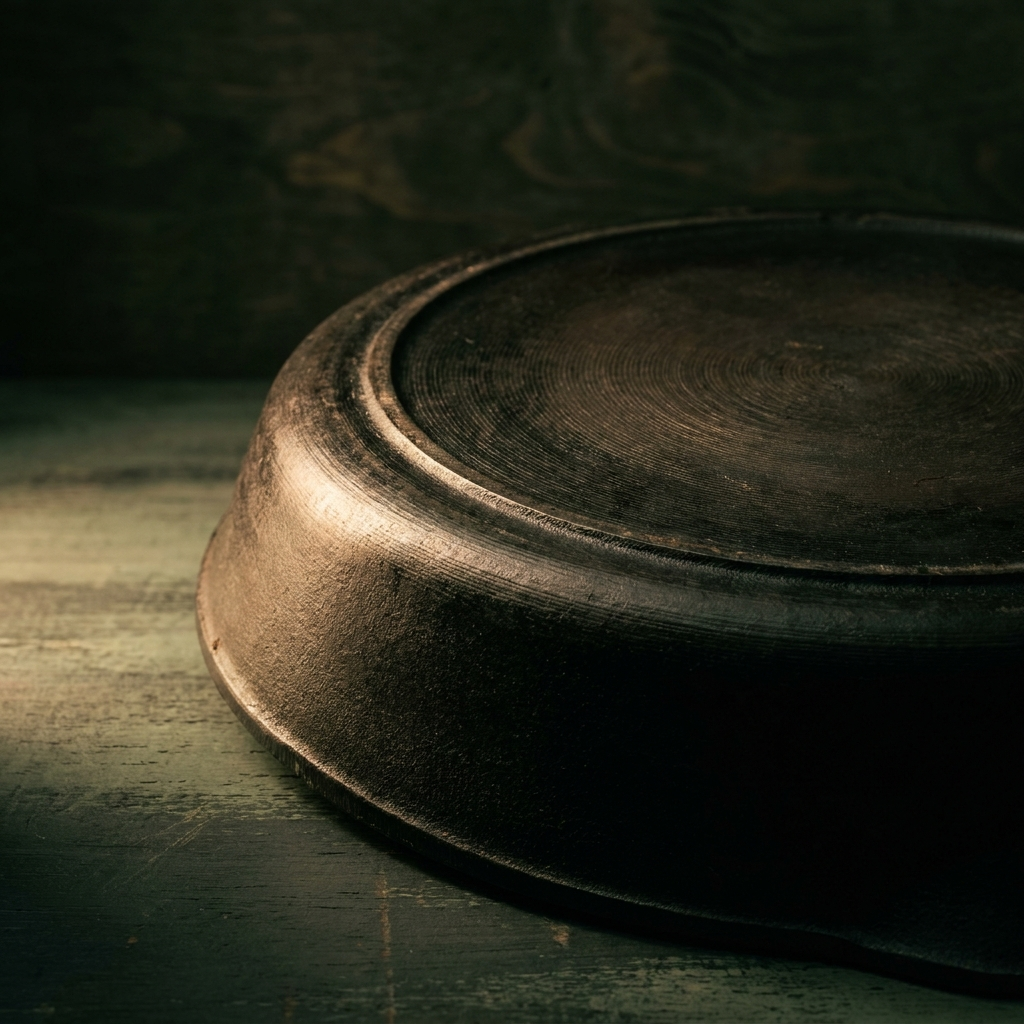
A raised ring around the outside of the bottom is a heat ring, and it marks a pan from the vintage era. Modern pans skip it. A rough, raised line running across the bottom is a gate mark, left by the casting process, and it usually means 19th-century production. Vintage pans were machined smooth inside; a pebbled cooking surface with no heat ring means a modern pan, and vintage Griswold is also noticeably lighter and thinner than modern cast iron.
Pattern numbers and size numbers are different things
The big number on the handle or bottom is the size (#8 is the common 10.5-inch skillet). Griswold also cast a three- or four-digit pattern number (#8 is pattern 704) that collectors use to pin down the exact variation. Both matter for pricing.
Spotting a reproduction
Reproductions of collectible Griswold and Wagner pieces flooded in from Asia in the late 1980s, and the Cast Iron Collector's fakes guide lists the tells: rough, unpolished surfaces, sans-serif lettering where the original used serifs, uneven letter spacing, wrong weight, and occasional misspellings in the pattern numbers. Toy skillets, corn-stick pans, and cake molds are the most-faked pieces.
Condition: the value multiplier
Condition sets the price. Set the pan on a flat counter and press each edge: a pan that rocks is warped, a "spinner," and warping cuts the collector value sharply. Hairline cracks often hide under old seasoning and appear only after the pan is stripped. Pitting can't be repaired, and fire-damaged iron turns scaly and dull red.
Old seasoning and rust don't hurt value, because collectors strip pans anyway. Lye baths and electrolysis are collector-approved restoration methods. Don't oil a pan for photos, though, since experienced buyers assume a shiny pan is hiding something.
Which cast iron pans are NOT worth much (and why)?
Unmarked and modern pans. No logo usually means a budget foundry or a post-1960s pan. Modern Lodge is excellent cookware and worth about what it costs new.
Post-1959 Griswold. After Textron bought the company, the pans changed and the collector premium disappears.
Warped, cracked, or pitted pans. A spinner or a hairline crack drops a collectible pan to cooking value, and pitting is permanent.
Reproductions. A late-1980s import copy of a Griswold toy skillet is worth about $10.
Where is the best place to sell vintage cast iron?
eBay is where most collectible cast iron sells, usually in 3–14 days. Photograph the bottom flat and in raking light so the logo reads, note the size and pattern numbers in the title, and be honest about wobble. Double-box valuable pieces with two inches of padding on every side, because cast iron can shatter in shipping.
Collector groups and forums. The Griswold & Cast Iron Cookware Association and the Cast Iron Collector forum connect you with buyers who know exactly what a slant logo is worth.
Specialty auctions. Dinky's in Montgomery, Indiana and similar cast iron auctions are where the #13s, spiders, and kettle stands find their bidders. For a full breakdown of platforms and fees, see where to sell.
If you're not sure what you have, that's the part to solve first. Identifying the foundry and logo before you list, by hand or with a tool that shows you how AI appraisal works, is the difference between a $25 sale and a $285 one.
The bottom line
The skillet on your stove is probably worth $25–$75. But "probably" gets expensive when the bottom says "ERIE" in slanted letters and you sold it at the yard sale for $5.
The pans that command real money share a few traits: they're from Griswold, Wagner, or one of the smaller collectible foundries (confirmed by the logo, not assumed from the age), they're unusual sizes or early marks, and they sit flat with no cracks. Everything else is a wonderful, ordinary pan that will outlive you.
Turn it over. Read the logo. Set it on the counter and press the edges. It takes about a minute, and it's the difference between a pan you'd keep frying eggs in and one worth photographing carefully. If the same kitchen held old Pyrex or old china, the same logic applies: the mark on the bottom is where the value hides.
Most old cast iron skillets sell for $25–$75, including unmarked pans and 1960s-and-later Wagner and Lodge. Everyday-size pans from Griswold's slant and large block logo eras and Wagner's Sidney -O- era sell for $150–$400. Rare sizes, early marks, and specialty pieces sell for $1,000 to over $10,000. Value depends on the foundry, the logo era, the size, and whether the pan sits flat without cracks.
An ERIE Spider skillet from the 1890s, made in Erie, Pennsylvania before the Griswold name appeared on cookware, sold for $10,000 at auction in August 2024. Among regular skillets, Griswold's largest sizes lead: a large block logo #13 hammered at $3,200 in November 2025 and eBay sales of #14s have reached $3,249. A Griswold two-loaf bread pan sold for $11,250 at the same 2025 auction.
Turn the pan over. Griswold cast its name into the bottom, and the logo style dates it: the ERIE diamond (1884–1909), slanted 'Griswold' in a cross (1906–1929), large block letters (about 1920–1940), and small block letters (1939–1957). Wagner marked the bottom 'Wagner Ware Sidney -O-' and put the size number on the handle. A raised heat ring around the bottom and a smooth machined cooking surface both point to the vintage era.
Unmarked pans, modern Lodge with a pebbled cooking surface, and Griswold made after Textron bought the company in 1959 sell for cooking value only, usually under $40. Warped pans that rock on a flat counter, cracked pans, and pitted pans lose most of their collector value. Late-1980s reproductions of Griswold toy skillets and corn-stick pans are worth about $10.
eBay sells most collectible cast iron within one to two weeks; photograph the bottom in raking light and double-box for shipping. The Griswold & Cast Iron Cookware Association and the Cast Iron Collector forum connect you with knowledgeable buyers. Specialty auctions like Dinky's in Montgomery, Indiana handle rare sizes and specialty pieces worth $1,000 and up.