Is Your Costume Jewelry Worth Money?
Most costume jewelry sells for $1–$25, but signed pieces from Trifari, Eisenberg, and Haskell can bring hundreds. Here's how to spot the valuable ones.
Most vintage costume jewelry is worth $1–$25 per piece, but signed pieces from the great mid-century houses — Trifari, Eisenberg, Miriam Haskell, Weiss — regularly bring $100–$500, and the rarest reach into the thousands. The word "costume" describes the materials, not the value. What separates a $3 brooch from a $300 one is almost always a small mark on the back. Here's how to read it.
How much is vintage costume jewelry actually worth?
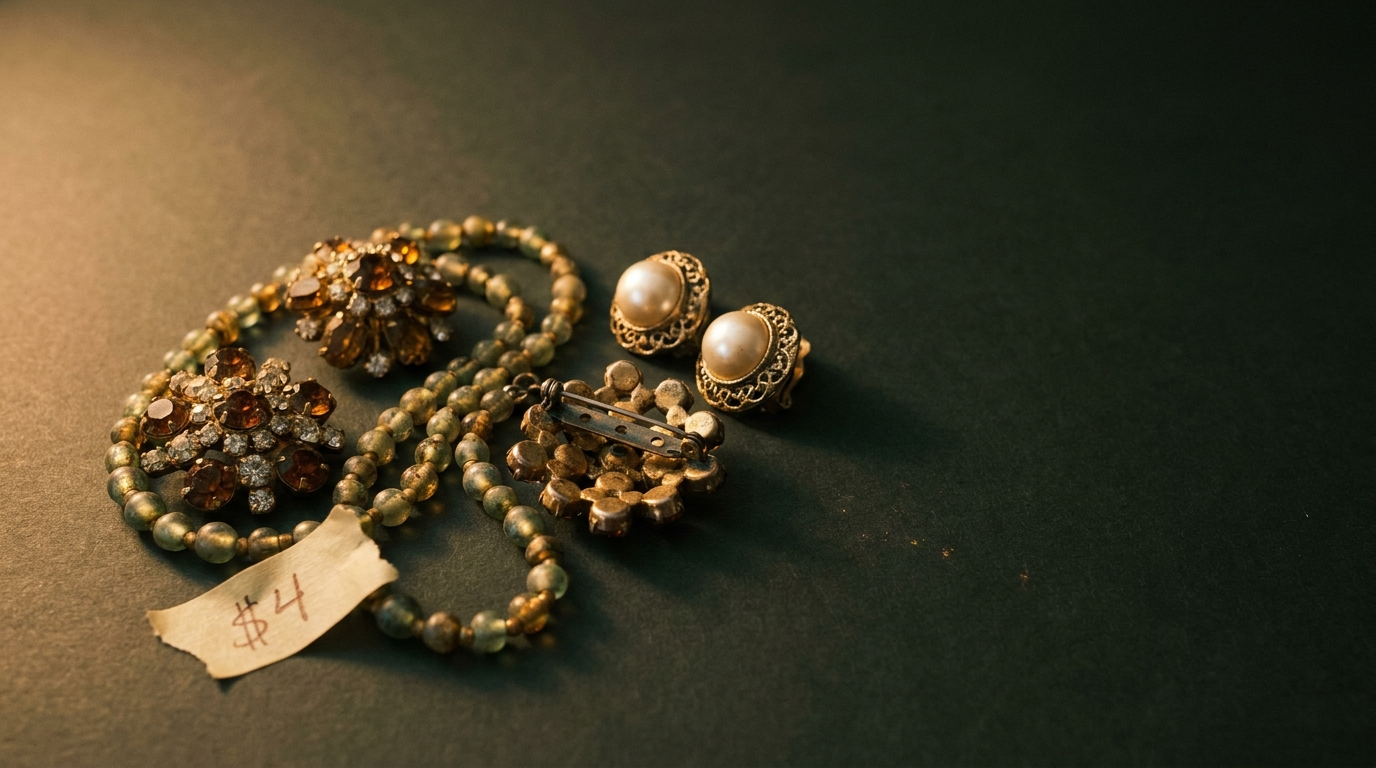
Most of it is worth a few dollars. The unsigned rhinestone brooch in the bottom of the jewelry box, the gold-tone chain with no mark — these were made by the millions, and the market still has more than it can absorb. Unsigned costume pieces typically sell for $1 to $25.
But a signed piece is a different object entirely. According to dealers who track the market, a clear maker's mark "can triple the retail value compared to an identical but unsigned piece." A signature is proof of who made it, when, and how well — and for the top houses, that proof is worth real money. Signed mid-tier pieces run $25–$100. Premium signed designs reach $100–$500. And the museum-grade rarities — poured-glass Chanel, wartime Trifari — clear $500 and keep going.
The distance between $3 and $3,000 comes down to the name on the back. Here's how to tell which one you're holding.
Which costume jewelry brands are worth real money?
The $500+ tier: the houses collectors chase
Trifari "Jelly Belly" (1940s). During World War II, metal went to munitions plants, so Trifari set clear Lucite "bellies" into gold-plated sterling animal pins — fish, frogs, turtles, birds. Each carries a design patent number from 1943–1945. On Antiques Roadshow, a pair was appraised at $625–$1,400 retail, and single rare examples climb higher. Look for the crown-over-T mark.
Chanel and Gripoix poured glass. Hand-poured glass brooches from Chanel's workshops are the top of the costume market, commonly bringing $750 to $2,500 or more at specialty auction.
Eisenberg Original (1930s–40s). Eisenberg started as a clothing company and gave brooches away with dresses — until people started buying the dress just for the pin. The early "Eisenberg Original" script pieces, set with large high-quality Swarovski crystals, are the ones collectors want most.
The $100–$500 tier: premium signed designs
Miriam Haskell. Known for intricate hand-wired seed pearls and glass on filigree backplates. Signed bead necklaces commonly list for $100–$300, with elaborate pieces reaching well past that.
Weiss (1942–1971). Prized for dazzling prong-set rhinestones and hand-set detail rivaling Austrian imports. Signed rhinestone brooches and the sought-after "Christmas tree" pins are steady sellers in this range.
Coro and Coro Duette. The Duette — two clips that lock into one brooch — is the collectible standout, listing around $75–$125, while rarer figural Coro pieces like the enameled Indian Chief brooch have sold closer to $383.
Eisenberg fur clips. The classic large rhinestone fur clips bring $100–$200 in excellent condition.
The $25–$100 tier: collectible and climbing
Signed pieces from Boucher, Napier, Monet, Sarah Coventry, and later Trifari crown pins live here — real makers, real marks, modest but rising prices. Trifari crown pins run $50–$150. Monet gold-tone bracelets bring $30–$80. These aren't retirement money, but they're a real cut above unsigned, and the gap keeps widening as the mid-century supply is fixed and demand grows.
How do you identify valuable costume jewelry?
The mark is everything
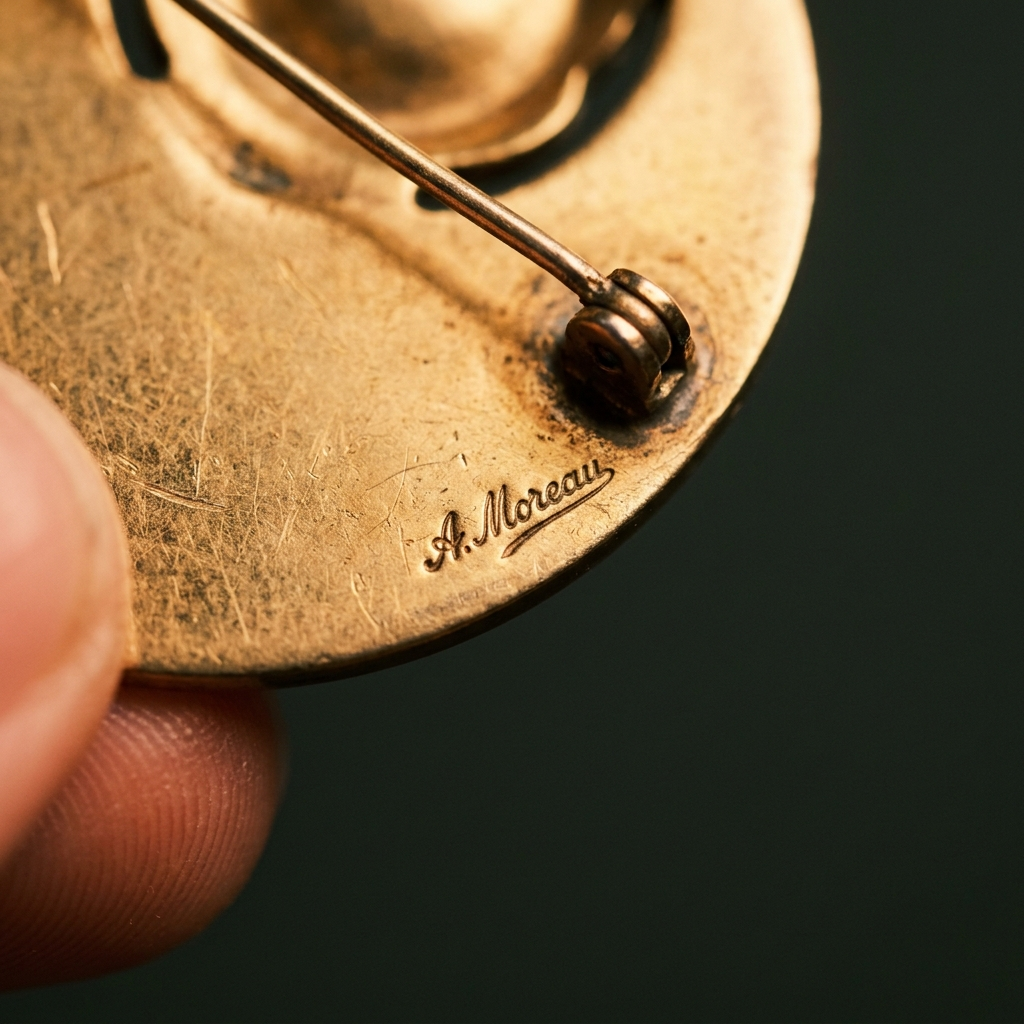
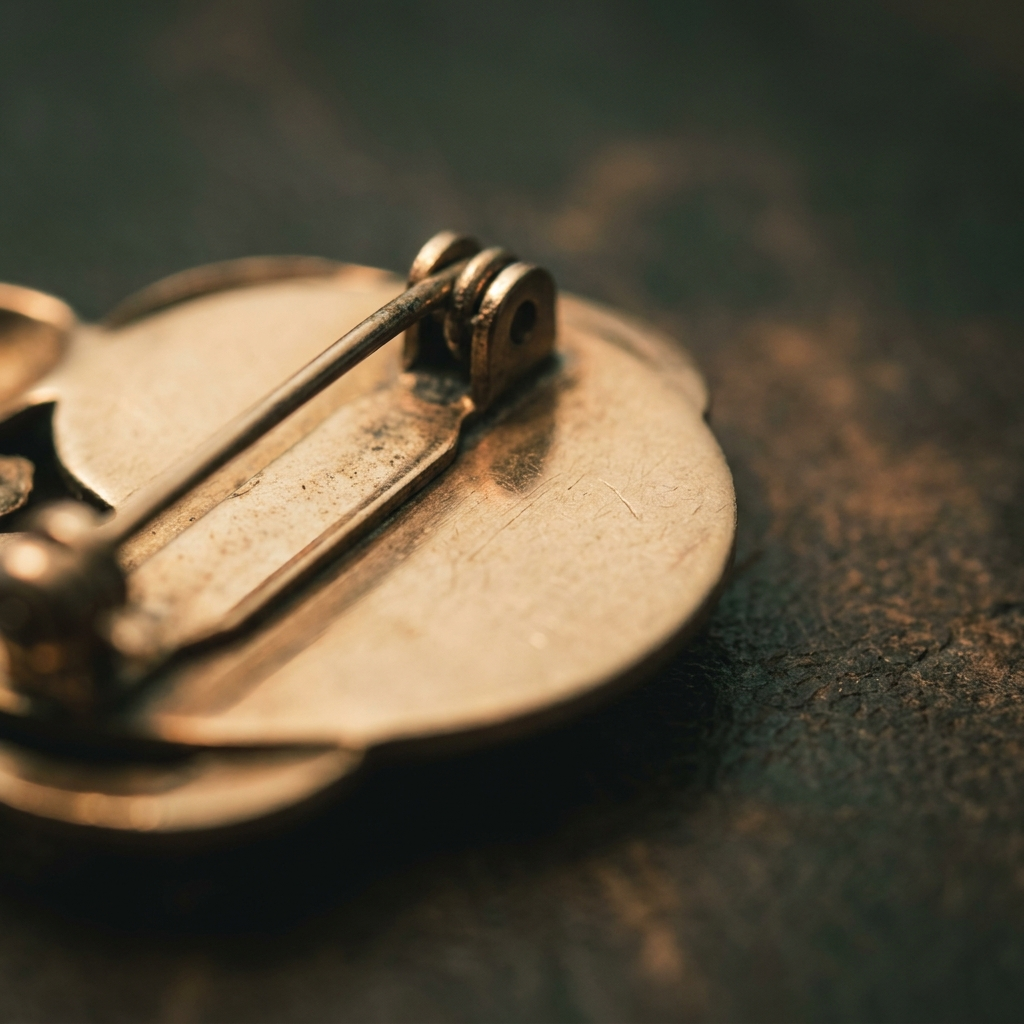
This is the whole game. Flip the piece over and look for a signature — on the back of a brooch, inside a bracelet band, on a necklace clasp or a small metal tag. Use a magnifying glass; many marks are tiny. A maker's mark is the single biggest factor in what a piece is worth.
Each house has a signature to learn. Trifari used a crown over the "T," or "Trifari" in script. Weiss stamped or engraved "WEISS." Eisenberg appears in script or block, with the earliest and most valuable reading "Eisenberg Original." A copyright © symbol next to the mark dates the piece to after 1955, which helps narrow the era. For a deeper walkthrough of hallmarks and dating cues, see our guide to vintage jewelry identification.
Condition: the value multiplier
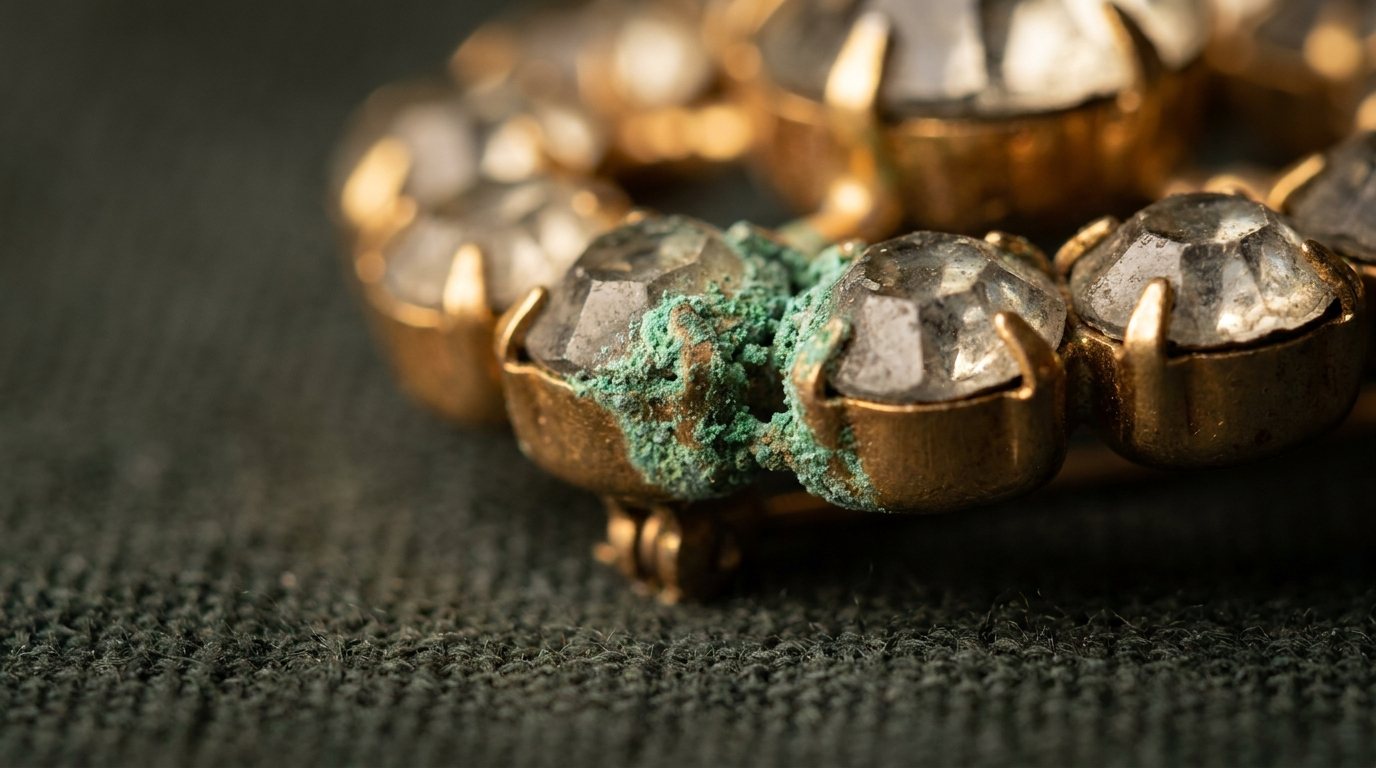
A signature gets you in the door; condition decides the price. The specific enemy of costume jewelry is verdigris — the crusty green corrosion that forms where metal meets old glue, especially around set stones. It eats the finish and, left alone, spreads. Light verdigris can sometimes be cleaned; heavy verdigris permanently hurts value.
The other big one is missing or dead stones. A rhinestone piece is only as good as its sparkle. Foil-backed stones go cloudy or gray when moisture gets behind the foil, and an empty setting is an obvious flaw. Original prongs beat re-glued replacements every time. Enamel should be intact, without chips or flaking.
Which costume jewelry is NOT worth much (and why)?
Unsigned rhinestone pieces. Pretty, plentiful, and usually $1–$25. Without a mark, there's no name to pay for.
Mass-market 1970s–80s gold-tone. Bulk chains and generic clip earrings from the tail end of the costume era saturate every thrift bin.
Anything with heavy verdigris or a graveyard of empty settings. Collectors pass, and cleaning rarely brings it back to grade.
"Signed" pieces with worn-off marks. If the signature is illegible, you lose the premium a mark provides — buyers pay for provenance they can read.
Where is the best place to sell costume jewelry?
eBay offers the widest reach and the best pricing tool: filter "sold listings" for your exact maker and style to see what pieces actually closed at, not what hopeful sellers are asking.
Etsy rewards photogenic, well-styled signed pieces and draws buyers who appreciate vintage design.
Specialist dealers and auctions are worth it for the top tier — a genuine Jelly Belly or poured-glass Chanel deserves an audience that knows what it's looking at.
For sorting a whole box — especially inherited jewelry where the good and the ordinary are tangled together — start by separating signed from unsigned before you decide what goes where. Our full breakdown of platforms and fees lives in where to sell.
Two research resources worth knowing: Costume Jewelry Collectors International hosts a free A–Z marks archive built by hundreds of collectors, and the Kovels price guide database lets you search past sold prices by maker.
The bottom line
Your grandmother's jewelry box is probably worth $50, not $5,000. But "probably" gets expensive when a signed Eisenberg is sitting under a pile of unsigned clip earrings.
The pieces that command real money share a pattern: a legible mark from a house collectors track, clean condition with live stones and no verdigris, and a design that shows the craftsmanship the great makers were known for. Everything else is decoration — lovely to wear, light to sell.
So before the box goes to the donation pile, turn every piece over. The mark on the back takes ten seconds to check, and it's the difference between a $2 giveaway and a brooch worth more than the gold necklace next to it.
Most vintage costume jewelry sells for $1–$25 per piece, especially unsigned items. But signed pieces from top mid-century makers — Trifari, Eisenberg, Miriam Haskell, Weiss — commonly bring $100–$500, and the rarest reach the thousands. A clear maker's mark can triple the value versus an identical unsigned piece. The key factors are the signature, the condition (no verdigris, intact stones), and the maker's collectibility.
Chanel and Gripoix poured-glass pieces sit at the top of the costume market, commonly bringing $750–$2,500+ at specialty auction. Wartime Trifari 'Jelly Belly' pins (clear Lucite set in gold-plated sterling, 1943–1945) were appraised at $625–$1,400 on Antiques Roadshow. Early Eisenberg Original brooches with large Swarovski crystals and signed Miriam Haskell pieces are also highly sought after.
Flip the piece over and look closely — often with a magnifying glass — at the back of brooches, the inside of bracelet bands, necklace clasps, and small metal tags. Common marks include a crown over 'T' or 'Trifari' script, 'WEISS,' 'Eisenberg' or 'Eisenberg Original,' and 'Coro.' A copyright © symbol next to the mark means the piece dates to after 1955.
Verdigris is the crusty green corrosion that forms where metal meets old glue, most often around set stones in costume jewelry. It damages the finish and spreads over time. Light verdigris can sometimes be cleaned, but heavy verdigris permanently reduces value. Along with cloudy foil-backed stones and empty settings, it's one of the top condition problems collectors watch for.
eBay offers the widest reach and the best pricing tool — filter 'sold listings' by maker to see real closing prices. Etsy works well for photogenic, well-styled signed pieces. For top-tier rarities like Jelly Belly pins or poured-glass Chanel, specialist dealers and auctions reach buyers who recognize the value. Always separate signed from unsigned before deciding where each piece goes.