Are Old Rugs Worth Money? How to Tell
Most old rugs sell for $50–$300, but hand-knotted Persian and Turkish rugs bring $3,000–$25,000 at auction. Here's how to read the back of the rug.
Most old rugs are worth $50–$300, but hand-knotted rugs from Persia, Turkey, and the Caucasus sell for $3,000–$25,000 at auction, and the rarest weavings reach the millions. A circa-1910 Persian Heriz sold at Bonhams Skinner for $3,072, an 1880s Turkish Oushak brought $10,880, and a Navajo first-phase chief's blanket set the record for an American textile at $1.8 million. What separates a $100 rug from a $10,000 one is how it was made, where, when, and in what condition. All of that is readable from the back. Here's how.
How much is an old rug actually worth?
Most old rugs are worth $50–$300. Machine-made "Oriental style" rugs from the 1970s through 1990s, most braided and hooked rugs from the mid-century, and worn room-size wool rugs of uncertain origin fall here. Vintage braided rugs on eBay list from $65 to about $270 for common sizes, and House Digest reports the braided rug is having a comeback in 2026 under the "grandmacore" trend, which helps the good ones sell.
The middle tier lives at $500–$3,000. Karastan, the American machine-made exception, holds value: used Karastans on 1stDibs average about $960 and reach $7,000. Mid-century Moroccan Beni Ourain rugs hammered at $500–$750 at Material Culture. Pictorial hooked rugs with folk-art appeal reach this tier too: a 1930s Hutchinson pictorial sold at Pook & Pook for $3,200.
The top tier starts around $3,000 and depends on origin, age, and knot quality. Hand-knotted Persian and Turkish rugs from before 1930 in room sizes sell for $3,000–$25,000, and the antique masterpieces go far beyond. The record is the Clark Sickle-Leaf carpet, a 17th-century Persian rug that sold at Sotheby's for $33.7 million in 2013.
Which old rugs are worth real money?
The $10,000+ tier: antique Persian, Caucasian, and Navajo
Antique Persian city rugs (Tabriz, Kashan, Sarouk). Finely knotted rugs from Persia's weaving centers, made before about 1930. A Mohtashem Kashan sold at Nazmiyal for $20,000, a signed antique Tabriz brought CHF 8,250 at Koller, and a Tabriz palace carpet hammered at €38,872 at Bruun Rasmussen.
Antique Turkish Oushak. The soft, large-scale designs decorators love. An 1880s Oushak sold at Bonhams Skinner for $10,880 in August 2025, and a rare 17th-century Star Oushak brought $25,600.
Navajo weavings. First-phase chief's blankets from the mid-1800s are the most valuable American textiles. One sold at John Moran for $1.8 million in 2012, and a blanket a California man had kept in a closet sold for $1.5 million. Germantown "eye-dazzlers" from the 1880s appraise at $15,000–$25,000.
The $2,000–$10,000 tier: Heriz, Kazak, and folk-art hooked rugs
Persian Heriz and Serapi. The geometric, rust-and-navy village rugs that anchor a living room. A circa-1910 Heriz sold at Bonhams Skinner for $3,072 in November 2024, and an antique Serapi hammered at $12,000 at Nazmiyal in June 2025.
Caucasian Kazak. Bold, tribal, and collected hard. A circa-1880 Sewan Kazak sold at Bonhams Skinner for $6,400 in March 2024.
Grenfell and pictorial hooked rugs. Hooked mats from the Grenfell Mission in Newfoundland and Labrador, made from the 1910s on, sell for $4,000–$6,000: a "Shadows" mat brought $5,605 at Miller & Miller in 2024.
The $300–$2,000 tier: worn Persians, Karastan, and Beni Ourain
Room-size Persian rugs from the 1930s–1960s with honest wear, Karastan's Axminster-loomed wool rugs from 1928 onward, mid-century Moroccan Beni Ourain, and Scandinavian rya rugs from named designers. A 1930 Kashan with wear sold at Austria Auction Company for €2,125, and a worn Sarouk brought €3,125 at Koller.
Under $300: what most rugs actually are
Machine-made polypropylene and wool-blend rugs from Belgium, Egypt, and Turkey made after 1970, most braided and hooked rugs without folk-art appeal, hand-tufted rugs with a glued canvas back, and anything with moth damage or dry rot. Useful and often beautiful. Not collectible.
How do you identify a valuable rug?
The back tells the story
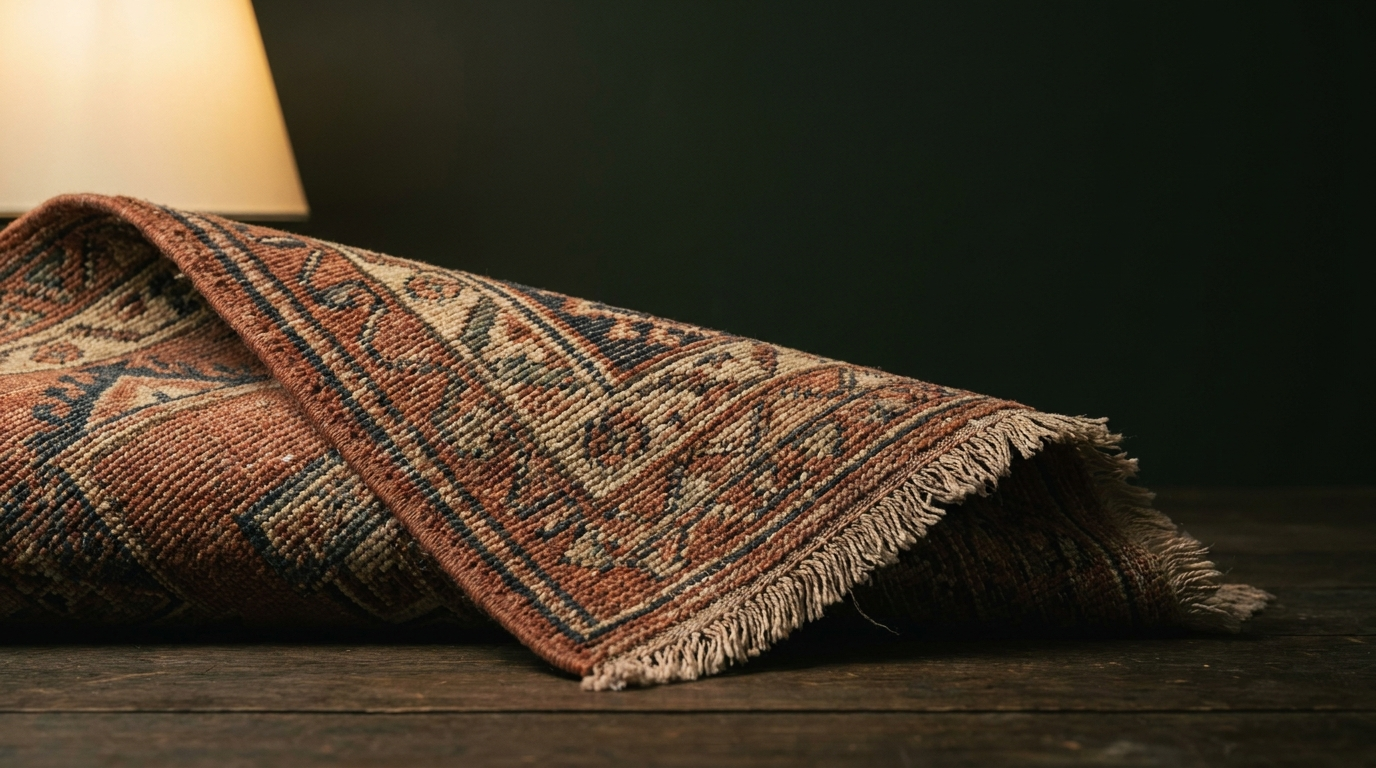
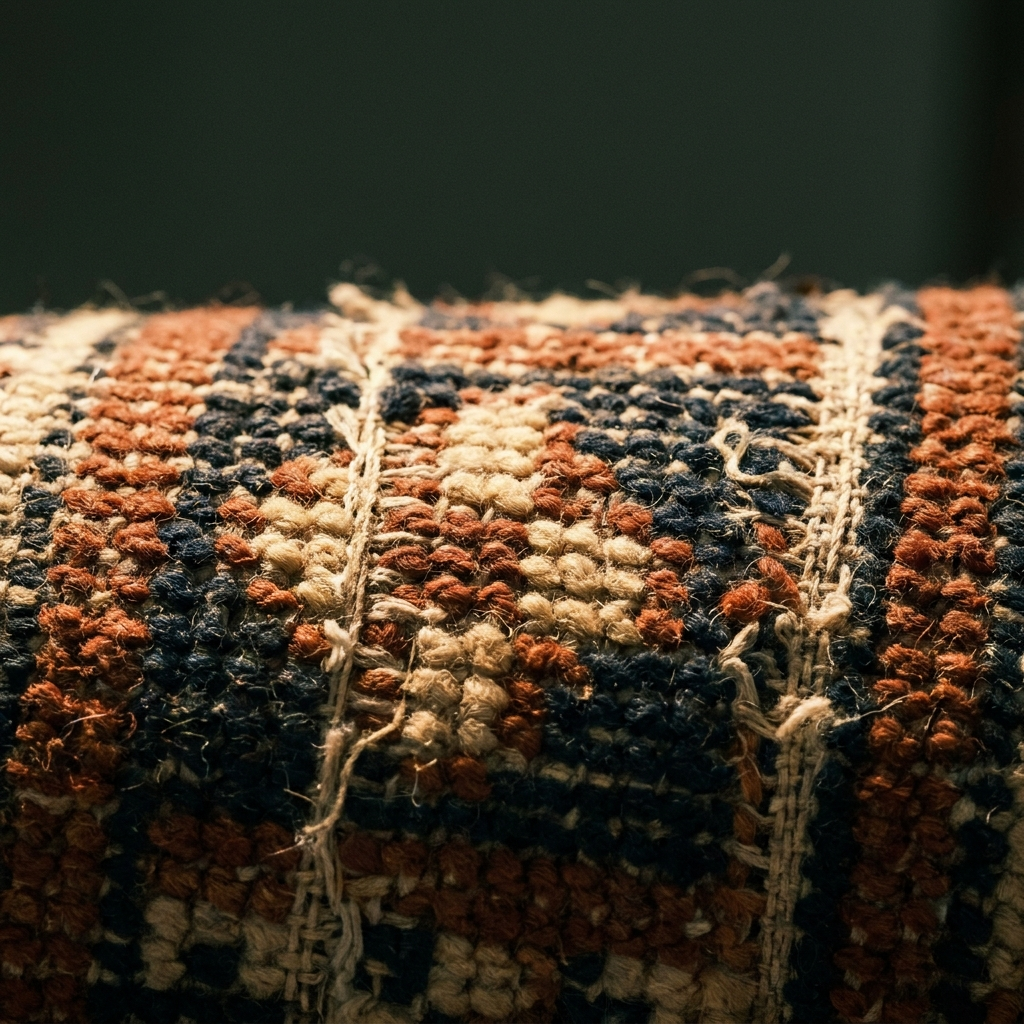
Turn a corner over. On a hand-knotted rug, you'll see the pattern clearly on the back, made up of thousands of slightly irregular knots, each tied by hand. A machine-made rug shows a flat, perfectly uniform back, often with a stiff latex or mesh coating. A hand-tufted rug, the most common trap, shows no knots at all, just a solid cloth backing glued over the yarn. Hand-tufted rugs look handmade from the front and are worth a fraction of hand-knotted ones.
The fringe grows out of the rug, or it doesn't
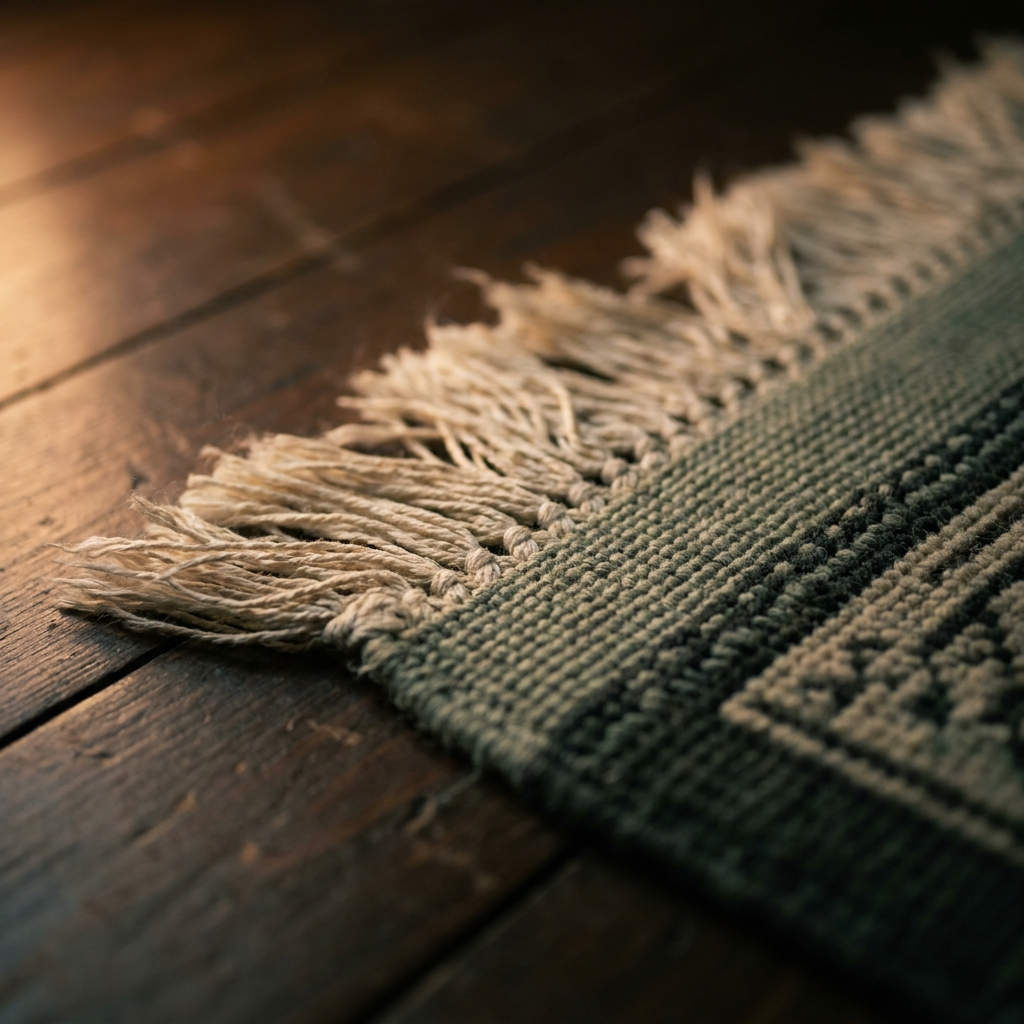
On a hand-knotted rug, the fringe is the warp threads the rug was woven on, so it continues straight out of the foundation. On machine-made and tufted rugs, the fringe is a separate strip sewn or glued on afterward. Tug gently at the base of the fringe and look at where it meets the rug.
Knots per square inch and the dyes
Count the knots along one inch horizontally and one inch vertically on the back and multiply. Coarse tribal rugs run 70–80 knots per square inch, city rugs about 100, fine rugs 200 and up. Knot count is one factor among several, not a price by itself.
Look at the colors, too. Rugs woven before the 1920s used natural dyes that vary slightly from row to row, a striping effect called abrash. A rug with perfectly uniform color and no abrash was almost certainly made with synthetic dyes after the 1920s. The back of an old rug feels gritty or smooth; a new rug feels fuzzy.
Condition: the value multiplier
Condition sets the price. Low pile, holes, moth damage, stains, and poor repairs reduce value sharply. Fold a corner sharply and listen: a crackling sound or a powdery foundation means dry rot, which is usually fatal to value. Check for "painted" rugs, where a dealer used dye markers to hide worn spots: blot a damp white cloth on a worn area, and if color transfers, the rug has been painted and will bleed when cleaned. Honest, even wear on an antique rug is expected and priced in. Damage that can't be reversed is what costs you.
Which old rugs are NOT worth much (and why)?
Hand-tufted rugs. The most common "looks handmade" trap. A glued canvas back means the yarn was punched through a backing with a tool, and the rug is worth $50–$200 regardless of how it looks from the front.
Machine-made rugs after 1970. Belgian, Egyptian, and Turkish power-loomed rugs were made in enormous quantities. Karastan is the exception that holds value.
Rugs with dry rot, active moths, or painted repairs. These problems can't be fixed, and buyers who know rugs check for all three.
Most braided and hooked rugs. Charming and back in fashion, but common. The exceptions are pictorial folk-art hooked rugs and Grenfell mats.
Where is the best place to sell an old rug?
Rug dealers buy hand-knotted rugs outright and know the market, but expect a wholesale offer. Get two.
Auction houses. Bonhams Skinner runs dedicated carpet sales, and Material Culture, Nazmiyal, and regional houses handle everything from Beni Ourain to Kazak. Seller's commissions typically run 10–25% on rugs under $5,000, so auction makes sense for rugs worth $1,000 and up.
Chairish and 1stDibs work for decorative vintage rugs, including Karastan and mid-century Moroccan pieces, where design-minded buyers pay retail.
eBay and Facebook Marketplace handle braided, hooked, and machine-made rugs where local pickup avoids shipping a heavy roll. For a full breakdown of platforms and fees, see where to sell.
If you're not sure what you have, that's the part to solve first. Identifying the construction and origin before you list, by hand or with a tool that shows you how AI appraisal works, is the difference between a $100 sale and a $3,000 one.
The bottom line
The rug in the guest room is probably worth $50–$300. But "probably" gets expensive when it's a 1910 Heriz with uneven knots on the back and you gave it to the movers.
The rugs that command real money share a few traits: they're hand-knotted (confirmed by the back and the fringe, not assumed from the pattern), they come from a weaving tradition collectors track, and they've survived without rot, moths, or paint. Everything else is a lovely, ordinary rug.
Turn the corner over. Look at the knots. Check where the fringe meets the foundation. It takes about a minute, and it's the difference between a rug you'd leave on the curb and one worth calling a dealer about. If the same house held old furniture or a set of old china, the same logic applies: how it was made is where the value hides.
Most old rugs sell for $50–$300, including machine-made 'Oriental style' rugs from the 1970s onward and most braided and hooked rugs. Karastan, mid-century Moroccan, and worn antique Persian rugs sell for $500–$3,000. Hand-knotted Persian, Turkish, and Caucasian rugs made before about 1930 sell for $3,000–$25,000 at auction, and rare antique weavings reach the millions. Value depends on construction, origin, age, and condition.
The Clark Sickle-Leaf carpet, a 17th-century Persian rug, sold at Sotheby's in June 2013 for $33.7 million. The most valuable American textile is a Navajo first-phase chief's blanket, which sold at John Moran Auctioneers in 2012 for $1.8 million. A similar blanket that a California man kept in a closet sold for $1.5 million.
Turn a corner over. A hand-knotted rug shows the pattern clearly on the back in thousands of slightly irregular knots, and the fringe continues straight out of the foundation because it's the warp the rug was woven on. A machine-made rug has a flat, perfectly uniform back with fringe sewn or glued on. A hand-tufted rug has no knots at all, just a cloth backing glued over the yarn, and is worth far less than it looks.
Hand-tufted rugs with glued canvas backs, machine-made rugs from Belgium, Egypt, and Turkey made after 1970, and most plain braided and hooked rugs sell for under $300. Rugs with dry rot (a crackling, powdery foundation), active moth damage, or painted-over wear lose most of their value because the damage can't be reversed.
Rug dealers buy hand-knotted rugs outright at wholesale prices. Auction houses like Bonhams Skinner, Material Culture, and Nazmiyal handle rugs worth $1,000 and up, with seller commissions of roughly 10–25%. Chairish and 1stDibs suit decorative vintage rugs like Karastan and Beni Ourain. eBay and Facebook Marketplace work for braided, hooked, and machine-made rugs where local pickup avoids shipping.